

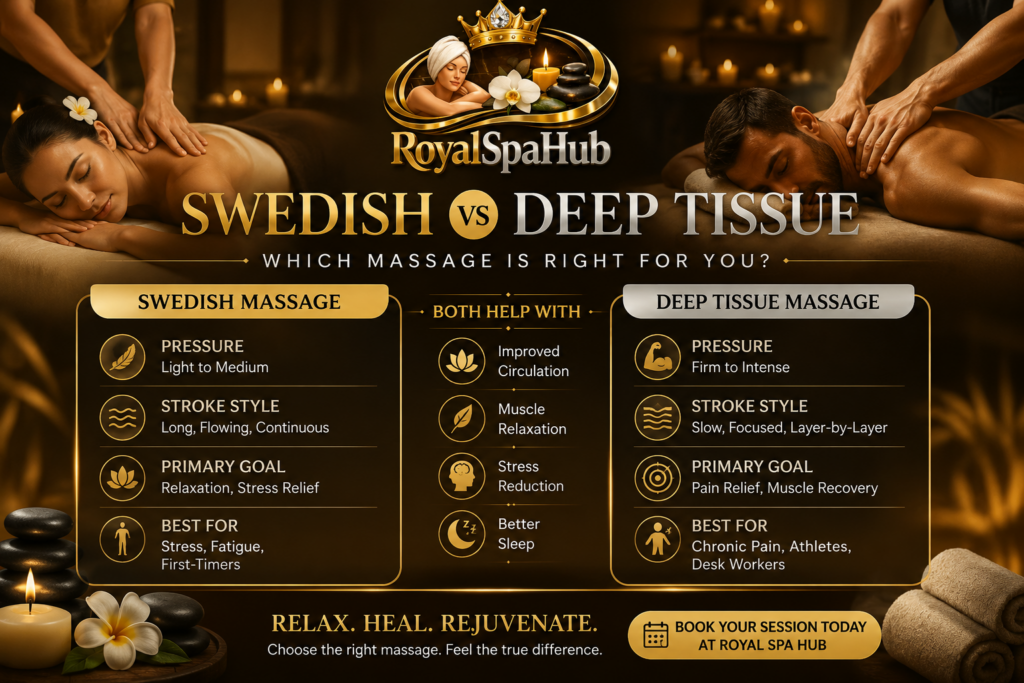
Confused between Swedish and deep tissue massage? Compare pressure, benefits & results to pick the right one. Book your session at Royal Spa Hub.
Understanding Swedish vs Deep Tissue Massage
If you’ve ever stood at a spa counter wondering whether to pick Swedish massage vs deep tissue massage, you’re not alone. Both promise relief, but they work in almost opposite ways — one melts stress away with slow, flowing strokes, the other digs into stubborn knots with firm, targeted pressure. Picking the wrong one isn’t the end of the world, but it can mean leaving without the result you actually wanted. This guide breaks down exactly how Swedish and deep tissue massage differ, who each one suits best, and how to choose confidently before your next session.
Swedish massage uses light-to-medium pressure and long, gliding strokes to relax the whole body and ease everyday stress. Deep tissue massage uses firm, sustained pressure to reach deeper muscle layers and release chronic tension or pain. Choose Swedish for relaxation, deep tissue for muscular pain relief.
What Is Swedish Massage?
Swedish massage is often called the “classic” massage — and for good reason. It’s built around five core techniques: effleurage (long gliding strokes), petrissage (kneading), friction, tapotement (rhythmic tapping), and gentle stretching. The goal isn’t to fix a specific problem; it’s to calm the nervous system, improve circulation, and leave you feeling lighter and looser.
How does Swedish massage feel? Swedish massage feels smooth, rhythmic, and consistently gentle — like a wave moving across your body rather than a targeted push. Pressure stays light to medium throughout, and therapists work over the whole body rather than isolating one area. Most people find it deeply relaxing rather than intense.
A typical session moves across your back, shoulders, arms, legs, and neck using warm aromatherapy oils, which is part of why it’s the go-to choice for couples and first-timers.
Best for: everyday stress, poor sleep, mental fatigue, mild muscle tightness from sitting or travel, and anyone who simply wants to unwind.
What Is Deep Tissue Massage?
Deep tissue massage borrows some of the same strokes as Swedish massage but applies far more pressure, working slowly through the muscle layers instead of gliding over them. The intent is therapeutic: therapists use fingers, knuckles, forearms, and sometimes elbows to reach connective tissue and release adhesions — the “knots” that form from chronic tension, poor posture, or overuse.
Is deep tissue massage painful? Deep tissue massage can feel intense and occasionally uncomfortable in tight areas, especially in the first few minutes, but it shouldn’t be sharply painful. A skilled therapist adjusts pressure to your tolerance and checks in throughout — genuine pain is a signal to speak up, not something to push through.
Sessions often focus on specific problem zones — lower back, shoulders, neck, or legs — rather than the full body, and many clients feel soreness the next day, similar to how muscles feel after a workout.
Best for: chronic back or neck pain, muscle stiffness from gym training, recovery after long flights or road trips, and postural tension from desk jobs.
Swedish vs Deep Tissue Massage: Key Differences
| Factor | Swedish Massage | Deep Tissue Massage |
|---|---|---|
| Pressure | Light to medium | Firm to intense |
| Stroke style | Long, flowing, continuous | Slow, focused, layer-by-layer |
| Primary goal | Relaxation, stress relief | Pain relief, muscle recovery |
| Coverage | Full body | Targeted problem areas |
| Post-session feel | Light, calm, refreshed | Slightly sore, released, loosened |
| Ideal for | Stress, fatigue, first-timers | Chronic pain, athletes, desk workers |
| Typical duration | 60–90 minutes | 60–90 minutes |
Which One Should You Choose?
Choose Swedish massage if:
- You want to de-stress rather than treat a specific pain point
- It’s your first professional massage
- You’re booking a couple’s spa session
- You’ve had a mentally exhausting week, not a physically strenuous one
Choose deep tissue massage if:
- You have ongoing back, neck, or shoulder pain
- You train regularly and need muscle recovery
- You sit at a desk for 8+ hours a day and feel stiff by evening
- A previous Swedish massage felt “nice” but didn’t actually relieve your tension
How do I know which massage pressure is right for me? If you can’t remember the last time your muscles felt genuinely sore or tight, Swedish massage’s lighter approach is likely enough. If you regularly feel knots, stiffness, or pain in specific spots — even after a good night’s sleep — deep tissue’s targeted pressure is built to address that.
Two Insights Most Spa Blogs Won’t Tell You
1. You don’t have to pick just one. Many Royal Spa Hub clients in Delhi NCR book a hybrid session — Swedish strokes to open up the body for the first 20–30 minutes, followed by focused deep tissue work on one or two problem areas (usually the neck, shoulders, or lower back). This avoids the “walked in stiff, walked out relaxed but still stiff” outcome that happens when someone picks pure Swedish for a genuinely tight muscle problem.
2. Delhi NCR’s commute and AC-heavy office culture change what your body actually needs. Long hours in cars or metros with the neck angled toward a phone, combined with constant air-conditioning, tends to tighten the upper trapezius and neck far more than it does in less commute-heavy cities. If that’s your daily routine, a Swedish massage alone often skips right past the actual problem area — worth flagging to your therapist before the session starts, not after.
Common Mistakes to Avoid
- Booking deep tissue as your very first massage. If your body isn’t used to targeted pressure, start with Swedish or a moderate hybrid session first.
- Not communicating your pain tolerance. “Firm” means different things to different therapists — say so if it’s too much or too little within the first five minutes.
- Skipping hydration afterward. Deep tissue work releases metabolic waste from muscle tissue; drinking water afterward helps reduce next-day soreness.
- Getting a deep tissue massage right before an important event. Mild soreness for 24 hours is normal — avoid booking it the day before a big meeting or event if you’re new to it.
Who Should Avoid Deep Tissue Massage?
Deep tissue massage isn’t right for everyone. Avoid it, or check with your doctor first, if you have:
- Recent surgery or open wounds
- Blood clotting disorders or are on blood thinners
- Severe osteoporosis
- Acute injuries or inflammation (in the first 48–72 hours)
- Pregnancy (a prenatal-specific massage is safer)
Swedish massage is generally gentler and suitable for most people, but pregnant clients should still opt for a prenatal-trained therapist. [VERIFY: confirm any additional medical contraindications with a licensed physician before publishing.]
People Also Ask
Can I combine Swedish and deep tissue massage in one session?
Many spas, including Royal Spa Hub, offer hybrid sessions that open with Swedish strokes to relax the body before shifting to deep tissue pressure on specific tension areas. This is often more effective than choosing one technique for a body that has both general stress and localized pain.
Which massage is better for back pain — Swedish or deep tissue?
Deep tissue massage is generally more effective for back pain, especially if it’s linked to muscle tightness or poor posture. Swedish massage can help with mild, stress-related back tension, but it won’t reach the deeper muscle layers where chronic pain usually originates.
Does deep tissue massage hurt more than Swedish massage?
Deep tissue massage involves more pressure and can feel intense in tight areas, but it shouldn’t be sharply painful. Swedish massage stays light to medium throughout and rarely causes any discomfort, making it the gentler option overall.
How often should I get a Swedish or deep tissue massage?
For general stress relief, a Swedish massage every 3–4 weeks works well for most people. For chronic pain or active muscle recovery, deep tissue sessions every 1–2 weeks tend to show more noticeable, lasting improvement.
Is deep tissue massage good for athletes?
Deep tissue massage is widely used by athletes to relieve muscle tightness, speed up recovery between training sessions, and address specific problem areas caused by repetitive strain.
FAQ
Q: Which massage burns more calories or helps with weight loss?
Neither massage is designed for weight loss. Both primarily support relaxation or muscle recovery. Any circulation benefits are a side effect, not a fat-loss mechanism — treat claims otherwise with caution.
Q: How long does a Swedish or deep tissue massage session last?
Both typically run 60 or 90 minutes at Royal Spa Hub, though 90-minute sessions allow more thorough work, especially for deep tissue on multiple problem areas.
Q: Will I feel sore after a deep tissue massage?
Mild soreness for 24–48 hours is common and normal, similar to post-workout soreness. It typically fades on its own; light stretching and hydration help speed recovery.
Q: Can beginners get a deep tissue massage?
Yes, but it’s worth telling your therapist it’s your first time so they can moderate pressure and build up intensity gradually rather than starting at full pressure.
Q: What oils are used in Swedish massage?
Most therapists use light aromatherapy oils such as lavender or eucalyptus to enhance relaxation, though preferences can be adjusted based on skin sensitivity or scent preference.
Swedish & Deep Tissue Massage in Delhi NCR
Delhi clients booking either massage often come from high-stress, high-commute lifestyles — long hours near Connaught Place, Nehru Place, or Cyber Hub-adjacent office corridors, where neck and shoulder tension from screen time and traffic stress is common. A hybrid Swedish-to-deep-tissue session tends to work especially well here, since it addresses both the mental fatigue and the physical tightness that build up over a Delhi workweek.
Gurgaon clients, especially those working in corporate hubs like DLF Cyber City, frequently book deep tissue sessions specifically for shoulder and lower-back tightness tied to long desk hours.
Noida professionals near sectors like 62 and 18 often choose Swedish massage after long commutes on the expressway, when the goal is winding down rather than treating a specific injury.
Ghaziabad clients typically look for accessible, home-style spa comfort combined with either technique, without needing to travel into central Delhi.
Why Book This With Royal Spa Hub
At Royal Spa Hub, every therapist is trained in both Swedish and deep tissue technique, so you’re never locked into the wrong choice — your therapist can adjust pressure and technique mid-session based on what your body actually needs, not just what you booked. Sessions use premium aromatherapy oils, a calm, private setting, and a genuinely warm, professional approach that puts your comfort first from the moment you walk in.
Whether you’re after a rejuvenating escape from the week or therapeutic relief from a stubborn knot, our signature approach is built around real results, not a one-size-fits-all script.
📲 Book your session on WhatsApp: +91 9289838779
Which Massage Is Right for You?
Choosing between Swedish and deep tissue massage really comes down to one question: are you treating stress, or are you treating pain? Swedish massage relaxes the whole body with gentle, flowing strokes, while deep tissue massage works deeper to release chronic tension and muscular pain. If you’re unsure, a hybrid session — or simply a conversation with your therapist before you begin — is the easiest way to get it right. Ready to feel the difference for yourself? Book your session today at Royal Spa Hub.